
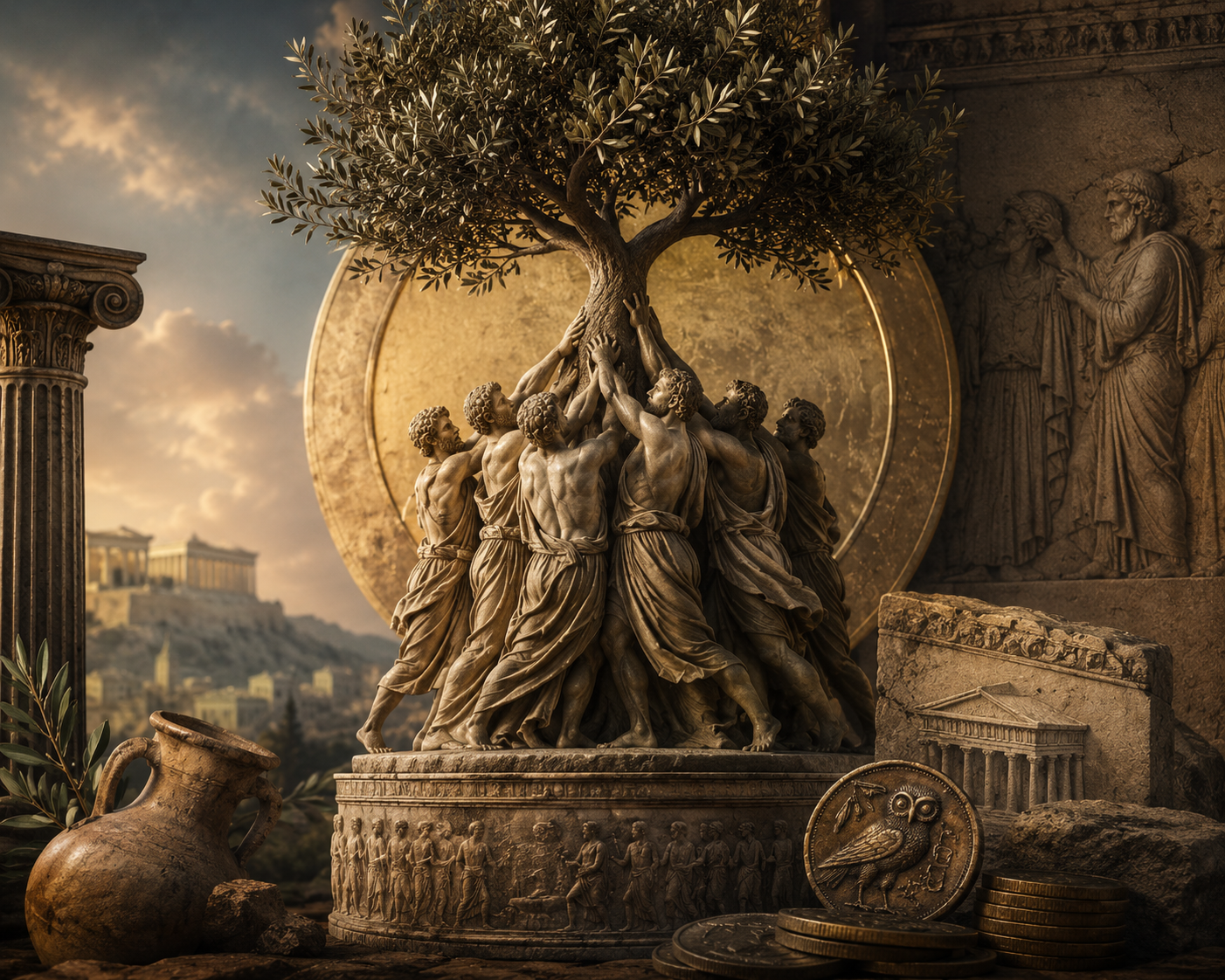
“Always remember to build bridges between unlikely allies and co-create solutions to uplift our global human family.”
A New Model for the AI Era
We are living through the fastest accumulation of private wealth in recorded history. And nearly all of it is flowing in one direction.
The richest 1% of U.S. households now own 31.7% of all national wealth — the highest share the Federal Reserve has ever recorded. Much of that growth came directly from AI-linked stock market gains, concentrating the financial returns of the AI revolution among those who already owned the most.
The numbers beneath that headline are starker still. During the AI-driven market surge of 2024–2025, the top 10% of U.S. households saw their wealth grow by $5 trillion in a single quarter, while the bottom 50% gained just $150 billion. That is not a gap. It is a chasm. And it is widening by the quarter.
The Jobs Picture Is Just as Troubling
The displacement has already begun: quietly, and then all at once.
Goldman Sachs estimates that roughly 300 million full-time jobs globally could be affected by generative AI. Among workers aged 22–25 in the most AI-exposed roles, employment has already dropped 6% since late 2022. For young software developers specifically, the decline is nearly 20%. Goldman Sachs economists have called AI "the big story in 2026 in labor," and warn that if job losses accelerate, it could meaningfully pressure the Federal Reserve to intervene. Entry-level workers in their 20s and 30s entering knowledge and content creation sectors are likely to be most affected.
The Anthropic CEO has projected that AI could eliminate roughly 50% of white-collar entry-level positions within five years. An entire generation of workers may find the first rung of the career ladder has been removed. Not broken, but gone.
Inequality Has Never Remained Peaceful
History is unambiguous on what happens next.
The UN's World Social Report 2025 found that economic insecurity, rising inequality, and declining trust are already destabilizing societies worldwide. Nearly 60% of people globally fear losing their job and being unable to find new employment. Violent conflicts are now more widespread than at any point in the past 30 years.
Scholars since Aristotle have documented the link between persistent economic inequality and the propensity of individuals and groups to engage in social and political unrest. When people perceive the system as rigged — when the gains of a civilization-altering technology flow exclusively to those who already hold power — trust erodes, institutions fracture, and societies become volatile.
The UN has called for an urgent new policy consensus anchored in equity, economic security for all, and solidarity. The question is: who answers that call, and how?
This Idea Has Worked Before
The principle behind the Public Equity Fund is not new. It is proven.
In 1976, Alaska took a simple but radical step: it required that a minimum of 25% of annual oil royalties be set aside, invested, and paid out directly to citizens as a dividend, recognizing the equal right of every resident to a share in the state's natural wealth. Today, that annual payment — this year set at $3,284 per eligible Alaskan — represents not a handout, but a calculated return on shared assets, returning value to the very people who helped build and steward them.
In Israel, a different but equally instructive model took hold. In 1993, the government launched the Yozma initiative: a program that used strategic equity investment and matching funds to catalyze a venture capital industry virtually from scratch. Within five years, Israel went from a single active VC fund to a thriving high-tech ecosystem, earning the nation the moniker "Startup Nation."
And in Norway, the world's largest sovereign wealth fund now stands equivalent to $1 million for every Norwegian family of four — invested across more than 9,000 companies in 70 countries — born from the conviction that a nation's windfall belongs to all of its people, not only those who happened to hold equity when the resource was discovered.
The technology revolution now underway dwarfs any oil field ever found. The question is whether we will apply the same wisdom, or repeat the mistakes of every prior era that failed to.
This Is the Moment — and the Answer
The Public Equity Fund has been established on a foundational conviction: if artificial intelligence becomes the infrastructure of civilization, then humanity itself deserves a stake in the value being created. It began with The Magnificent Humanity Pledge.
This is not charity. It is not a government program. It is a new model of leadership — one that recognizes that long-term trust, social stability, and shared human flourishing are not obstacles to the AI era. They are its prerequisites.
Founded in direct response to Pope Leo XIV's encyclical Magnifica Humanitas — his urgent call to ensure technology remains in service of the human person — the Public Equity Fund is seeded by personal founder equity, not corporate obligation. It costs existing shareholders nothing. It asks of its founders everything: the willingness to believe that how we build this era matters as much as what we build.
How the Fund Is Capitalized
Every sovereign wealth model in history has depended on one design choice: dedicating a real, growing asset to the people, rather than a discretionary line item subject to the next budget cycle. The Public Equity Fund follows that same discipline.
Founder equity as the seed asset. The Fund is anchored by The Magnificent Humanity Pledge — a personal commitment of founder equity in AI ventures, starting with a pledge of 10% of founder equity in MAXIOM. Think “Giving Pledge for AI.” This is deliberately structural, not charitable: equity, like Alaska's oil royalties or Norway's petroleum revenue, is a claim on future value creation, not a one-time gift. As the underlying AI enterprises grow, so does the asset base available to the Fund.
Invest before it distributes. Consistent with the Alaska and Norway models, pledged equity is not spent — it is held and invested by the Fund, so the corpus compounds over time and dividends are paid from returns and realized gains rather than from principal. This is what allows a fund seeded today to sustain payouts for generations, not years.
Open to other founders, not just MAXIOM's. The Fund is designed as a vehicle other AI founders and companies can join by making their own equity pledges, following the logic of the Giving Pledge: a public, values-based commitment that others can adopt on their own terms. The more of the AI economy's founder equity that flows into the Fund, the larger the base of shared ownership becomes.
Measuring What Matters: The Labor & Flourishing Index
A fund without a compass risks becoming just another pool of capital. To direct both its investment strategy and its distributions, the Fund is guided by the Magnificent Humanity Labor & Flourishing Index — a scorecard built around four pillars that track AI's real impact on workers and communities: economic security, skills and opportunity, dignity of work, and social cohesion. The Index is what turns "helping people" from a slogan into something measured, reported, and acted on — identifying which regions, sectors, and worker populations are being most displaced by AI, so capital and support reach them first rather than last.
Dividends to Families
The most direct expression of the Fund's purpose is a regular, direct cash dividend paid to families and workers displaced or affected by AI-driven labor disruption — modeled on the Alaska Permanent Fund's approach of treating a shared windfall as a right of citizenship, not a favor. Rather than a one-time payment, the intent is a recurring dividend, sized to the Fund's returns, that gives families a predictable floor to plan around: the ability to cover rent, food, and essentials with dignity while they navigate a labor market being reshaped faster than most institutions can respond to.
From Surviving to Flourishing
A dividend alone keeps a family afloat. It does not, by itself, help them flourish. So the Fund pairs direct payments with programs aimed squarely at rebuilding productive opportunity:
Reskilling and education stipends that fund workers to retrain into AI-complementary roles, trades, and emerging fields — chosen using Index data on where real opportunity is growing, not guesswork.
Entrepreneurship and small-business seed capital, so displaced workers can become owners and creators in the new economy rather than permanent recipients of it — echoing how Israel's Yozma initiative used catalytic capital to turn a handful of engineers into a nation of founders.
Community and institutional grants that strengthen the local infrastructure — schools, training centers, civic institutions — that the UN's own research identifies as the difference between a community that adapts to disruption and one that fractures under it.
Together, these are designed to move families along a continuum: from economic security, to new capability, to ownership and contribution — so that AI's dividend funds not just survival, but a real, durable stake in the economy it is transforming.
The Window Is Open
The window for getting this right is open. It will not remain so indefinitely.
"Each generation inherits the task of shaping its own era, of guiding history to become a place where the dignity of every person is safeguarded, justice is promoted and fraternity is made possible." — His Holiness Pope Leo XIV, Magnifica Humanitas
The Magnificent Humanity Public Equity Fund: full details on structure, governance, and participation to be announced.